


Restoring NYC’s Brownstones: Repair vs. Replacement

Preserving Historic NYC Brownstone Facades
Walk down the tree-lined streets of Brooklyn Heights, Park Slope, or the Upper West Side, and you’ll see the material that defines New York’s architectural identity: brownstone.
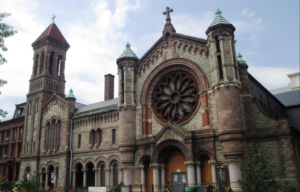 These classic tri-state facades give New York City its warmth and historical grit. Yet, behind their grand stoops and ornate lintels lies a geological paradox. Brownstone—a soft, triassic sandstone—was chosen in the 19th century largely because it was cheap, abundant, and easy to carve. Today, as these landmark structures cross the century mark, property owners and preservation boards face a critical choice: How do you repair deteriorating stone without destroying the building’s original soul?
A Brief History: How Sandstone Defined New York
Between the 1840s and 1890s, brownstone became the premier building material for NYC rowhouses. Quarried primarily in Portland, Connecticut, and parts of New Jersey, the stone was transported down the Hudson and Connecticut rivers directly to city docks.
Architects loved it because its soft composition allowed for elaborate, hand-carved details like acanthus leaves, pediments, and stoop balustrades at a fraction of the cost of marble or granite. However, that soft composition came with a shelf life.
Why Brownstone Fails: The Mechanics of Spalling
 If you’ve seen a brownstone facade with flaking, crumbling, or blistered stone, you’re looking at spalling—the primary enemy of historic sandstone.
Understanding why this happens comes down to three factors:
Face-Bedding Errors: Sandstone is a sedimentary rock formed in layers (bedding planes). When quarrymen installed stone blocks vertically with the layers facing outward (face-bedded) rather than horizontally (natural-bedded), water seeped between the layers like pages in a book.
The Freeze-Thaw Cycle: New York winters are brutal on porous stone. Moisture enters microscopic pores, freezes, expands by roughly 9%, and pops the outer face of the stone off.
Incompatible Past Repairs: In the mid-20th century, well-intentioned masons often patched brownstone with hard Portland cement. Because cement is far rigid and less permeable than natural sandstone, trapped moisture could not escape. Over time, the soft natural stone behind the cement crushed itself, leaving hollow shells of mortar ready to fall off.
Restoration vs. Replacement: Choosing the Right Approach
When evaluating a landmarked facade, preservation architects generally consider two paths: stucco/resurfacing (restoration) or dimensional stone Dutchmen/full-block units (replacement).

Preservation Rule: The NYC Landmarks Preservation Commission (LPC) strictly mandates that any restoration material must match the original stone in color, texture, profile, and compressive strength.
How Petrillo Stone Bridges History and Technology
Restoring or replacing historic brownstone requires more than basic masonry—it demands an understanding of historic stone chemistry combined with precise fabrication technology.
1. Digital Templating & 3D Scanning
Because original quarry sources like the Portland, CT quarry are largely closed, replacing missing or unsalvageable details requires exact replication. Using 3D laser scanning, we capture the exact geometry of weathered brackets, cornices, and rosettes directly from the facade without causing further harm to the structure.
2. Custom Stone Matching & Milling
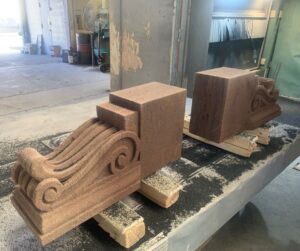
Using 5-axis CNC machines and precision waterjet cutting, we mill high-grade, low-porosity replacement sandstones (such as English Red Sandstone or matching domestic varieties) to the exact millimetric tolerances required by historic preservation guidelines.
3. Artisan Hand-Carving
While machines handle the heavy milling, human hands deliver the final character. Our master stonemasons hand-chisel the final textures, bush-hammered finishes, and carved motifs to mirror the authentic 19th-century craftsmanship of the original facade.
Preserving the Legacy
New York’s brownstones aren’t just buildings—they are living artifacts of the city’s architectural evolution. Whether executing a targeted Dutchman repair on a delicate window sill or fabricating a completely new limestone and brownstone entrance, proper restoration honors the past while building for the next century.